Measurement and analysis of optical surface properties for input to ShipIR

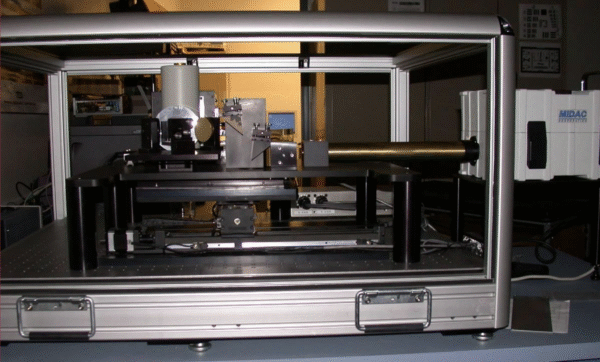
The application of advanced low observable treatments to ground vehicles has led to a requirement for a better understanding of effects of light scattering from surfaces. Measurements of the Bidirectional Reflectance Distribution Function (BRDF) fully describe the angular scattering properties of materials, and these may be used in signature simulations to quantitatively characterize the optical […]

Read more

Two evolutionary algorithms optimize clusters and automate feature selection in multispectral images

Evolutionary computation can increase the speed and accuracy of pattern recognition in multispectral images, for example, in automatic target tracking. The first method treats the clustering process. It determines a cluster of pixels around specified reference pixels so that the entire cluster is increasingly representative of the search object. An initial population (of clusters) evolves […]

Read more

Compact CMOS multispectral/polarimetric camera

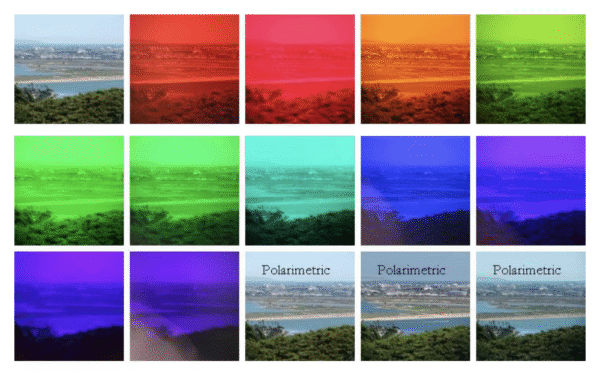
A novel, compact visible multispectral, polarimetric camera is under development. The prototype is capable of megapixel imaging with sixteen wavebands and three polarimetric images. The entire system encompasses a volume less than 125mm x 100mm x 75mm. The system is based on commercial megapixel class CMOS sensors and incorporates real time processing of hyperspectral cube […]

Read more

Performance and application of a very high-speed 2-12 μm ultraspectral FTIR imager

As an offshoot of hyperspectral imaging, which typically acquires tens to slightly more than 100 spectral bands, ultraspectral imaging, with typically more than 1000 bands, provides the ability to use molecular or atomic lines to identify surface or airborne contaminants. Surface Optics Corporation has developed a very high-speed Fourier Transform Infrared (FTIR) imaging system. This […]

Read more

Object discrimination and optical performance of a real-time 2-5 μm hyperspectral imager

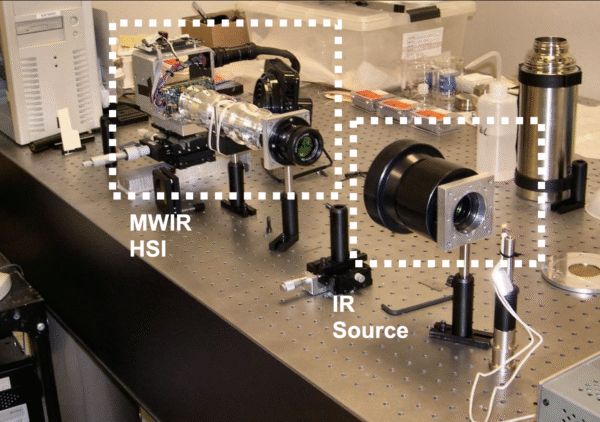
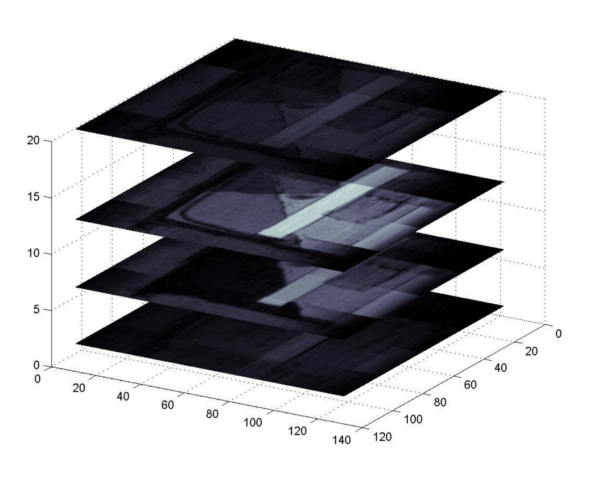
Abstract Hyperspectral imaging in the 2-5 um band has held interest for applications in detection and discrimination of objects of interest. Real time instrumentation is particularly powerful as a tool for characterization and field measurement. A compact, real-time, refractive MWIR hyperspectral imaging instrument has been designed and tested. The system has been designed for cryogenic […]

Read more

Progress towards a refractive real-time MWIR hyperspectral imager

Hyperspectral imaging in the 2-5 um band has held interest for applications in detection and discrimination of targets. Real time instrumentation is particularly powerful as a tool for characterization and field measurement. A compact, real-time, refractive MWIR hyperspectral imaging instrument has been designed and is undergoing integration and test. The system has been designed for […]

Read more

Bidirectional reflectance measurements for high-resolution signature modeling

The advancement of computer simulation tools for high fidelity signature modeling has led to a requirement for a better understanding of effects of light scattering from surfaces. Measurements of the Bidirectional Reflectance Distribution Function (BRDF) fully describe the angular scattering properties of materials, and these may be used in signature simulations to quantitatively characterize the […]

Read more

Design of dual-band SWIR/MWIR and MWIR/LWIR imagers

Multispectral imaging is a well accepted technique for object discrimination. Hyperspectral imaging can result in highly complex optical systems that have frame rate limitations. For fast frame rate applications, dual band imaging can provide sufficient discrimination without sacrificing signal to noise ratio. The design of a fast frame rate (> 200 Hz) SWIR/MWIR and MWIR/LWIR […]

Read more

Fabrication and thermo-optical properties of the MLS composite primary reflector

The Microwave Limb Sounder (MLS) is a limb-sounding radiometer sensing emissions in the millimeter and sub- millimeter range. MLS will contribute to an understanding of atmospheric chemistry by assessing stratospheric and tropospheric ozone depletion, climate forcings and volcanic effects. The heart of the antenna is the primary reflector, constructed from graphite/cyanate composites in a facesheet/core […]

Read more