
Introduction
Why can you see your face in a mirror, but not in a sheet of paper? Why does polished metal sparkle while concrete looks dull? And why do polarized sunglasses seem to “erase” glare from water?
At first glance, reflection seems simple: light hits a surface and “bounces” off. But the real story is more interesting than that. Reflection is not light behaving like a rubber ball. It is light interacting with electrons inside a material. At the smallest scale, reflection is a wave-and-matter problem. At the human scale, it is the reason objects look glossy, matte, metallic, bright, dark, or transparent.
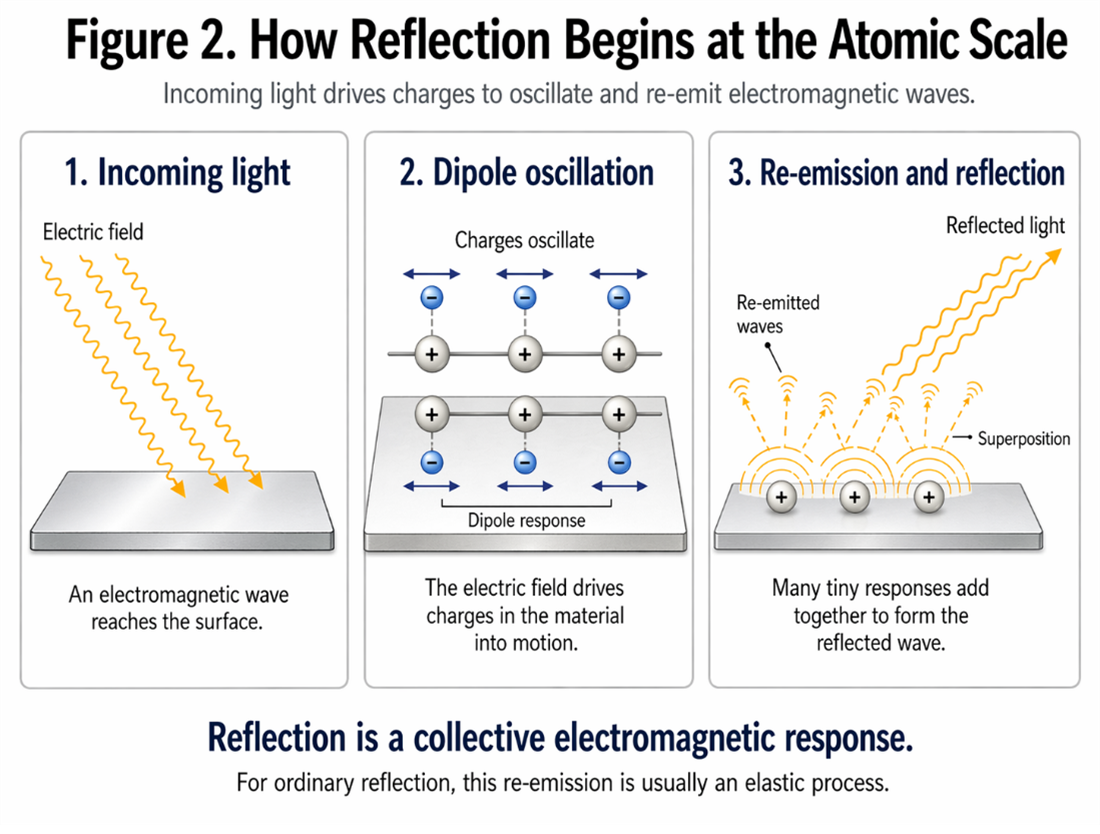
A material reflects light because the electric field of incoming electromagnetic radiation drives charges in the material to oscillate. In many cases, this can be described as a dipole oscillation response, where electrons are pushed back and forth by the light wave. Those oscillating charges then re-emit electromagnetic radiation.
For ordinary reflection, this re-emission is usually an elastic process, meaning the light is sent back out without first being fully absorbed, turned into heat, and emitted later. In other words, reflection is not usually absorption followed by delayed re-emission. It is a direct, near-instantaneous electromagnetic response of the material to the incoming wave.
That is why reflected light can preserve a clear direction and wavelength, while absorbed energy may later reappear in a very different form, such as thermal radiation.
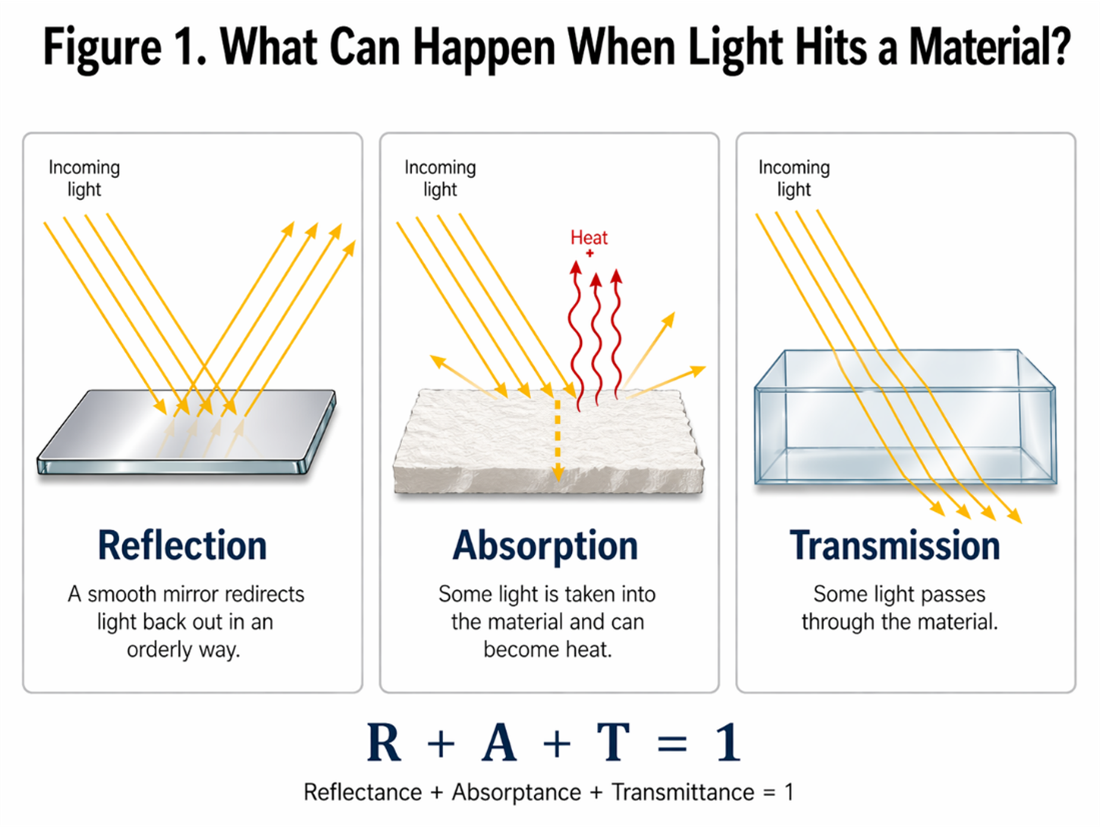
Light Meets Matter
Light is an electromagnetic wave, which means it carries oscillating electric and magnetic fields. When that wave reaches a material, its electric field pushes on charged particles, especially electrons.
You can think of the electrons near the surface as tiny responders, almost like microscopic antennas. As they accelerate, they generate electromagnetic waves of their own.
When huge numbers of atoms do this together, the result is not random. The outgoing light is shaped by superposition, the rule that waves add together. The reflected light we detect is the combined result of many tiny electromagnetic responses happening at once.
That helps explain why reflection can be so orderly. On a smooth surface, those tiny re-emitted waves line up in a way that strongly reinforces one outgoing direction. This is called specular reflection, the mirror-like kind that can preserve a clear image.
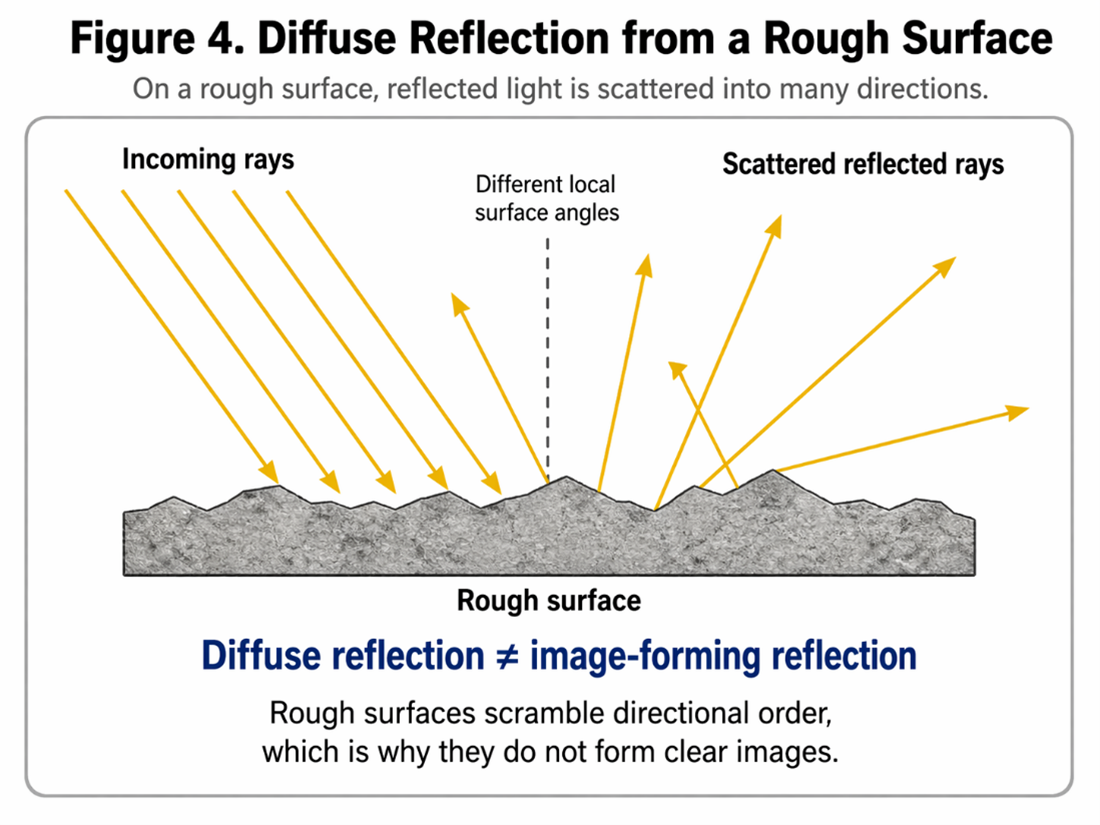
On a rough surface, the local orientation changes from point to point, so the re-emitted waves are spread into many directions instead. This is called diffuse reflection, which is why you can see paper, concrete, or a painted wall from many angles even though you cannot see your reflection in them.
This is one reason reflection is better understood as a collective electromagnetic response than as light simply bouncing off a surface.
Smooth Surfaces: The Orderly Mirror
If a surface is very smooth compared with the wavelength of light, the re-emitted waves remain well aligned. This is called specular reflection. The word specular comes from the Latin speculum, meaning mirror.
Specular reflection gives us:
- mirrors and polished chrome
- bright glare off a calm lake
- sharp highlights on a brand-new car
In specular reflection, the light follows the law of reflection: the angle at which the light hits the surface, called the angle of incidence (𝜃𝑖), is equal to the angle at which it leaves, called the angle of reflection (𝜃𝑟).
Because the outgoing light preserves its directional order, your eyes and brain can trace it back in a consistent way to form an image. That is why a mirror can show your face while a rough surface cannot.

Rough Surfaces: Scattering the Light
Now compare that to a piece of paper, a concrete sidewalk, or unpolished stone. At a microscopic level, these surfaces are rough on the scale that light cares about. Even if a material reflects light well, the surface may be covered with tiny bumps, slopes, and valleys.
When light hits those different local surface angles, each tiny region sends light in a slightly different direction. The result is that the reflected light is spread out rather than concentrated into one clean beam. This is called diffuse reflection.
Diffuse reflection is how we see most of the world. It is why you can see a white wall from almost anywhere in a room, even though you cannot see your face in it. The light is still being reflected, but the directional order needed to form an image has been lost.
The image of a mirror shattered into billions of tiny pieces is a useful mental picture. The deeper physical picture is that electrons across the surface still respond to the incoming light and re-emit electromagnetic waves, but because the surface orientation changes from point to point, the outgoing light is sent in many directions instead of just one.
The Energy Balance Sheet: Light’s Three Main Options
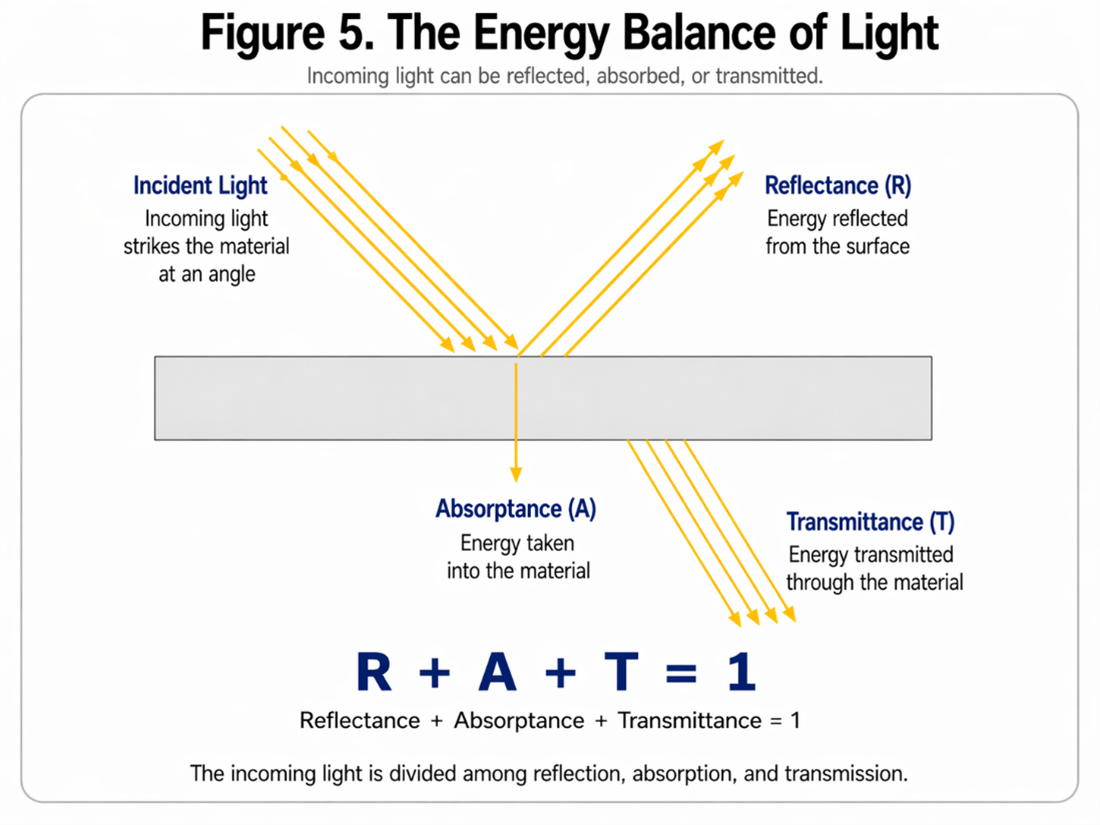
When light hits a material, the energy does not just disappear. It has to go somewhere. Physics tracks this with a simple conservation rule:
This is the balance sheet for incoming light, where:
- 𝑅 is reflectance, the fraction of light that is sent back out
- 𝐴 is absorptance, the fraction of light that is taken into the material
- 𝑇 is transmittance, the fraction of light that passes through the material
These three terms must always add up to 1, or 100 percent. Energy cannot vanish, and it cannot appear from nowhere.
The Opaque Rule
For many everyday solid objects, light does not pass through the material at all. A brick wall, a car door, or a piece of wood is effectively opaque, so:
𝑇=0
That simplifies the balance to:
𝑅+𝐴=1
This tells us something important: if a surface reflects less light, it must absorb more.
That is why a black shirt usually gets hotter in sunlight than a white one. The white shirt reflects more of the incoming light, while the black shirt absorbs more of it. Once that energy is absorbed, it can be converted into heat.
One Important Detail: Wavelength Matters
There is one more wrinkle. Reflectance, absorptance, and transmittance usually depend on wavelength.
That means a material can reflect one part of the spectrum strongly and absorb another. A red apple looks red because it reflects more red light and absorbs more of many other visible wavelengths.
This same idea matters far beyond color. Engineers use wavelength-dependent optical properties to design paints, coatings, windows, sensors, and even spacecraft surfaces.
Why Some Materials Are Shinier Than Others
Not all materials reflect the same amount of light. If you have ever wondered why a diamond sparkles more than a piece of glass, part of the answer lies in a property called the refractive index (𝑛).
The Speed Limit of Matter
The refractive index tells you how light travels through a material compared with how it travels in a vacuum. It is written as:
where:
- 𝑐 is the speed of light in a vacuum
- 𝑣 is the speed of light in the material
For many transparent materials, light travels more slowly than it does in a vacuum. For example, in ordinary glass, light travels at about two-thirds of its vacuum speed, giving glass a refractive index of about 1.5.
The Mismatch Rule: Fresnel Reflection
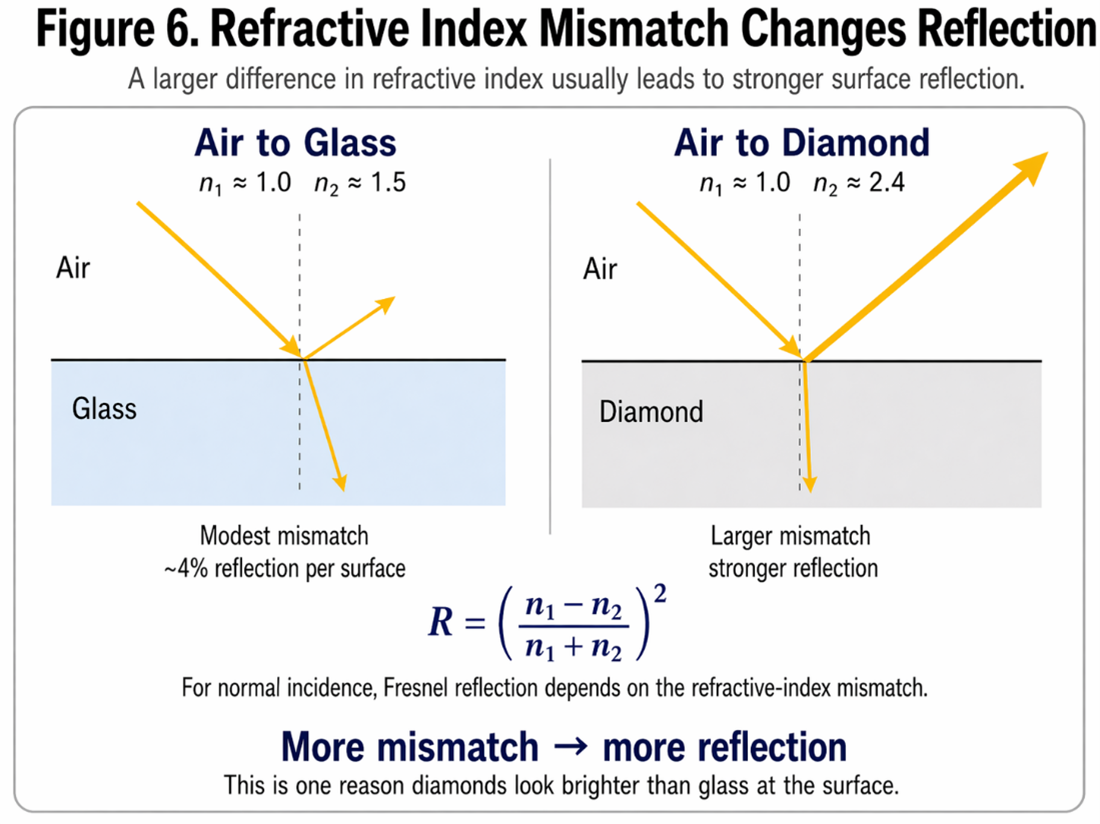
When light reaches a boundary between two materials, such as air and glass, some of it reflects and some of it transmits. For light arriving straight on, called normal incidence, the reflected fraction can be estimated with a simplified Fresnel equation:
The big idea is simple: the bigger the difference between the two refractive indices, the stronger the reflection tends to be.
- Air to glass: the difference is modest (1.0 vs. 1.5), so only about 4% of the light reflects at each surface. That is why glass can still look mostly transparent.
- Air to diamond: the difference is much larger (1.0 vs. 2.4), so the surface reflection is much stronger. That is one reason diamonds look so bright, though their sparkle also depends heavily on cutting and internal reflections.
Metals Play by Different Rules
Metals such as silver and aluminum are much shinier than glass, but they are also usually opaque. That is because metals contain many free electrons that can move easily in response to light.
In optics, metals are often described using a complex refractive index. One part describes how the wave propagates in the material, and the other part describes how strongly it is attenuated. Together, those properties help explain why metals can reflect such a large fraction of incoming light.
Because their electrons respond so strongly to electromagnetic waves, many metals have very high reflectance in the visible and infrared. That is why polished metal can look mirror-like even though it is not transparent.
Why Glare Can Disappear: The Role of Polarization
Polarized sunglasses can seem almost magical, but they are really a great example of optics in everyday life. They work because reflection does not depend only on the material and the angle. It also depends on polarization.
What is Polarization?
Light is an electromagnetic wave, which means its electric field can oscillate in different directions. A useful analogy is a rope: you can shake it up and down, side to side, or at some angle in between.
- Unpolarized light: light whose electric field points in many different directions
- Polarized light: light whose electric field is restricted to one direction or plane
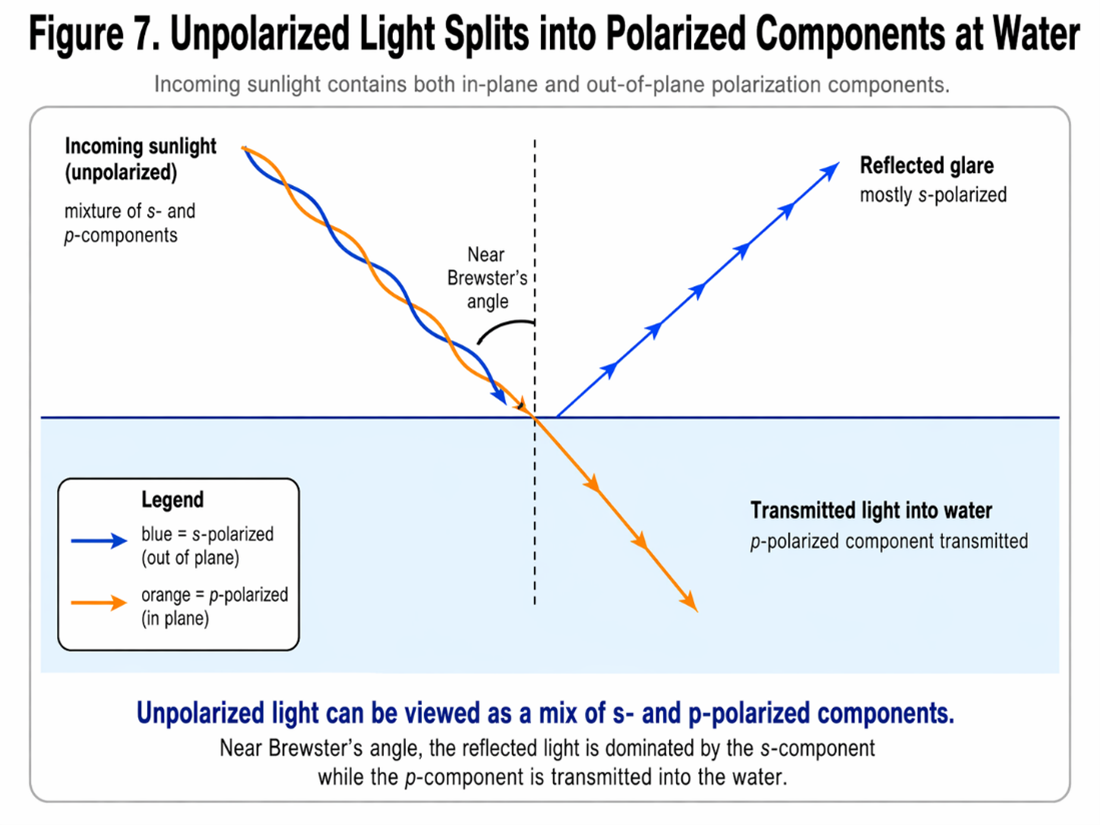
Sunlight is usually treated as unpolarized when it first arrives, but reflection from a surface can make the reflected light strongly polarized.
To describe polarization at a surface, physicists use two important terms:
- p-polarized light: the electric field oscillates parallel to the plane of incidence
- s-polarized light: the electric field oscillates perpendicular to the plane of incidence
The plane of incidence is the imaginary plane made by the incoming light ray and the line perpendicular to the surface, called the surface normal.
Brewster’s Angle: When One Polarization Stops Reflecting
When light hits a surface at most angles, some of it reflects and some of it transmits. But for a transparent dielectric material, there is one special angle called Brewster’s angle .
At this angle, the p-polarized component of the light is not reflected at all. Instead, it is transmitted into the material. Brewster’s angle is given by:
For light going from air into water , Brewster’s angle is about 53°.
That means the reflected light is dominated by the s-polarized component.
How Polarized Sunglasses Reduce Glare
This is where sunglasses come in. Glare from horizontal surfaces like roads, lakes, or windshields is often strongly polarized, with much of the reflected light vibrating horizontally.
Polarized sunglasses are designed to block that horizontal component while still letting much of the vertically polarized light pass through. As a result, the glare is greatly reduced, and it becomes easier to see into the water or through bright reflections on a road.
The glasses are not literally erasing all reflection, but they are removing a large part of the polarized reflected light that causes glare.
One Important Clarification
It is a common mistake to say that at Brewster’s angle the p-polarized light is “absorbed.” For an ideal transparent dielectric, that is not what happens. The key point is that the p-polarized light is transmitted, not reflected.
Whether that transmitted light is later absorbed depends on the material. But Brewster’s angle itself is about the reflected p-polarized component dropping to zero.
Why Reflection Matters: From Your Pocket to Outer Space
Reflection is not just a topic from physics class. It helps shape the technology we use every day, from the phone in your pocket to the satellites orbiting Earth. The same ideas that explain why a mirror works also help engineers design sensors, coatings, cameras, lasers, and spacecraft.
1. Remote Sensing: Reading Earth from Above
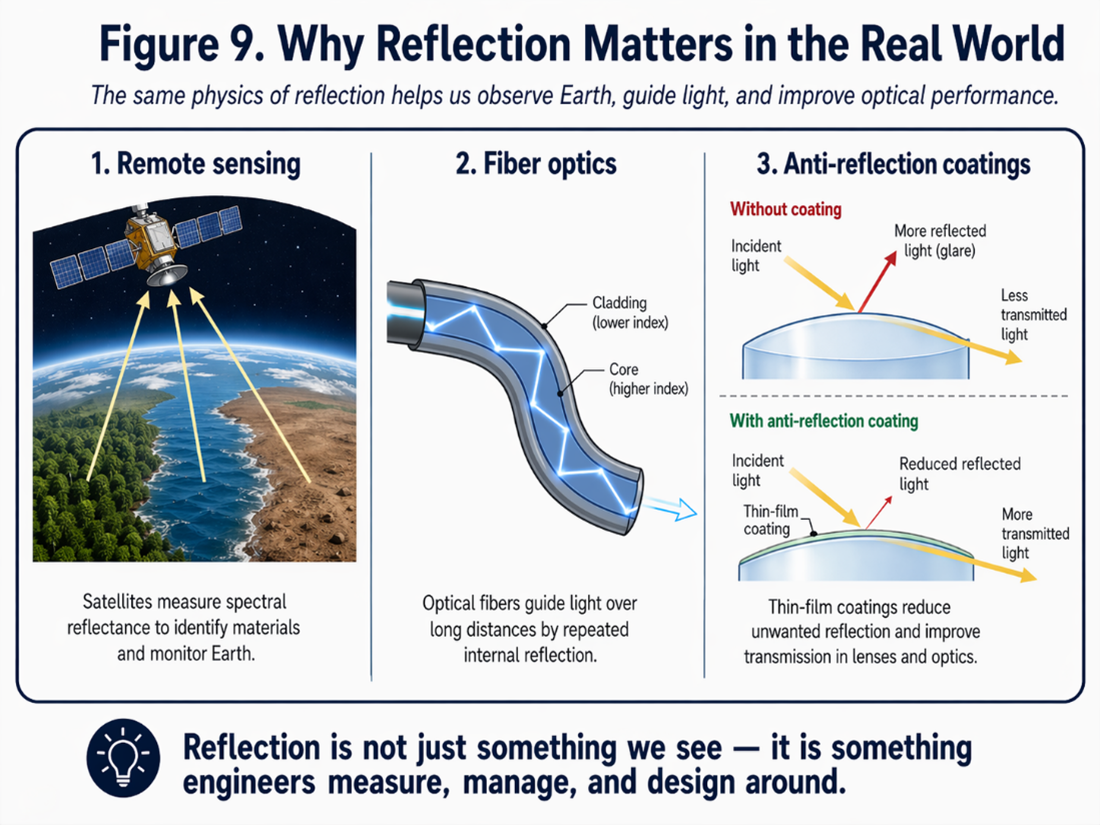
In remote sensing, scientists measure how different materials reflect different wavelengths of light. A forest, a glacier, a concrete roof, and a patch of dry soil all have different spectral reflectance signatures.
By measuring those differences from aircraft or satellites, scientists can monitor crop health, map wildfires, track ice and snow, study land use, and identify minerals from far above the ground.
2. Photonics and Optical Engineering
In optics and photonics, reflection is something engineers carefully control.
- Fiber optics: Light can be guided through glass fibers using total internal reflection, allowing information to travel long distances at high speed.
- Laser systems: Brewster’s angle can be used to reduce unwanted reflections and help control polarization inside optical systems.
- Anti-reflection coatings: Eyeglasses, camera lenses, and optical instruments often use thin-film coatings to reduce glare and improve transmission.
In all of these cases, reflection is not just something to observe. It is something to design around.
3. Everyday Surfaces, Everyday Physics
At the human scale, the same physics explains many familiar experiences.
- Mirrors preserve an image because specular reflection keeps the outgoing light well ordered.
- Paper and concrete look matte because diffuse reflection sends light in many directions.
- Polished metals look shiny because their electrons respond strongly to light.
- Roads and lakes can produce intense glare because reflection can become strongly polarized.
The world looks the way it does because materials reflect light in different ways.
Final Takeaway
The next time you notice your reflection in a window, glare off a road, or the shine of polished metal, you are seeing light interact with matter in a very precise way. Reflection may look simple, but beneath that simplicity is a rich combination of waves, electrons, surfaces, and energy balance.
Understanding reflection helps us do more than explain mirrors. It helps us measure materials, design better technologies, and make sense of the visible world.
Mastering the Vocabulary of Light
- Reflection: The process by which electromagnetic radiation is redirected by a surface back into the original medium.
- Reflectance: The fraction of incoming light that is reflected, often represented as 𝑅.
- Absorption: The process in which light energy is taken into a material and converted into internal energy, often becoming heat.
- Transmission: The process in which light passes through a material rather than being reflected or absorbed.
- Specular Reflection: Mirror-like reflection that occurs when a surface is smooth relative to the wavelength of light.
- Diffuse Reflection: Reflection that is spread into many directions because the surface is rough relative to the wavelength of light.
- Refractive Index (𝑛): A measure of how light travels in a material compared with a vacuum, often written as 𝑛 = 𝑐 / 𝑣.
- Fresnel Equations: The equations used to predict how much light is reflected and transmitted at a boundary between two materials.
- Polarization: The orientation of the electric field of a light wave.
- Plane of Incidence: The imaginary plane defined by the incoming light ray and the surface normal.
- p-Polarized Light: Light whose electric field oscillates parallel to the plane of incidence.
- s-Polarized Light: Light whose electric field oscillates perpendicular to the plane of incidence.
- Brewster’s Angle: The angle of incidence at which p-polarized light has zero reflection at an ideal dielectric boundary.
- Dipole Oscillation: The back-and-forth motion of charge driven by an incoming light wave; this motion can re-emit electromagnetic radiation.
- Elastic Process: A process in which the reflected light leaves with the same frequency as the incoming light.