
As manufacturing systems become increasingly automated and performance requirements continue to tighten, spectroscopic process monitoring technologies provide a path from periodic offline inspection toward continuous, real-time material characterization directly on the production line. Surface Optics develops custom FTIR and hyperspectral instrumentation engineered for integration into industrial process environments to deliver validated measurement data at the point of manufacture, at the speed that process control demands.
The Case for In-Line Spectroscopic Measurement
Conventional industrial quality assurance often relies on periodic sampling procedures: material is removed from production, transferred to a laboratory for analysis, and evaluated after manufacturing steps have already been completed. This model is fundamentally reactive. Defects, process drift, or material inconsistencies may only be identified after additional value has been added, increasing scrap risk, rework costs, and production delays.
In aerospace, defense, and advanced materials manufacturing, this delay presents additional challenges. Processes such as thermal coating deposition, composite layup, additive manufacturing, polymer curing, and specialty film fabrication often require tight control of chemistry, thickness, uniformity, and surface condition throughout production. Real-time spectroscopic monitoring enables these parameters to be measured continuously rather than inferred indirectly through periodic inspection.
Spectroscopic techniques, including near-infrared (NIR), mid-infrared (FTIR), and hyperspectral imaging, provide non-contact, non-destructive measurement of chemical composition, surface characteristics, coating uniformity, and material state with sub-second response times. These systems can detect subtle process deviations that are invisible to conventional machine vision inspection systems.
The practical challenge is integration. Laboratory spectrometers are designed for controlled environments and operator-supervised workflows. Industrial production lines require systems that tolerate vibration, thermal cycling, contamination, and continuous operation while interfacing directly with existing PLC, SCADA, and DCS architectures. Surface Optics develops integrated spectroscopic systems specifically engineered for these operational environments.
Hyperspectral Imaging for Industrial Inspection
Hyperspectral imaging (HSI) combines machine vision with spectroscopy by collecting a full spectrum at every pixel in an image. Instead of capturing only red, green, and blue color channels, hyperspectral systems acquire hundreds of contiguous spectral bands across portions of the electromagnetic spectrum ranging from the ultraviolet (UV) through the visible and infrared. The result is a three-dimensional data cube that contains both spatial and spectral information. By comparing the measured spectral signature of each pixel against known reference signatures for the target material or process condition, the system can identify areas where the material deviates from the expected spectral response. These anomalies, such as contamination, coating nonuniformity, material inconsistencies, or process defects, can then be spatially mapped across the inspected surface in real time.
In aerospace and industrial manufacturing, HSI is particularly effective for detecting:
- Coating thickness variation
- Surface contamination
- Composite material inconsistencies
- Moisture intrusion
- Thermal barrier coating defects
- Adhesive distribution irregularities
- Foreign object debris (FOD)
- Material mixing errors
- Surface chemistry variation
Pushbroom (line-scan) hyperspectral cameras are especially well suited for continuous production environments because they scale directly with conveyor or web speed while minimizing moving optical components.
Chemometric Model Development
Effective deployment of industrial hyperspectral systems depends on robust calibration and classification models. Surface Optics develops multivariate chemometric models tailored to the application, including:
- Partial least squares (PLS) regression
- Principal component regression (PCR)
- SIMCA classification
- Linear discriminant analysis (LDA)
- Spectral-spatial machine learning models
- Convolutional neural network (CNN) architectures
Models are trained using representative production datasets that account for variation in raw materials, process conditions, environmental factors, and product geometry. Validation and long-term maintenance strategies are incorporated into the system engineering process to support sustained operational performance.
Example: SOC MCP Hyperspectral Imaging System
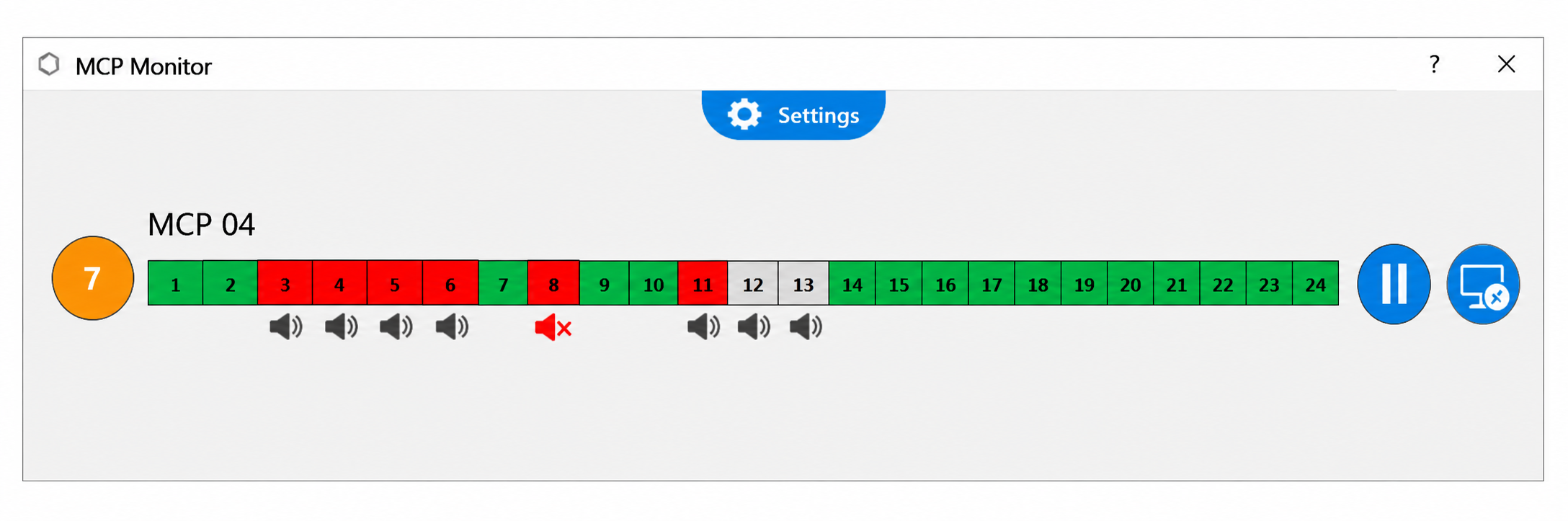
The SOC MCP Hyperspectral Imaging System is built around the SOC-710 hyperspectral camera and engineered for continuous in-line inspection in industrial processing environments. Fully integrated into the production line, the system performs real-time spectral analysis for quality inspection without interruption of production flow. Detection results are transmitted directly to the plant control system via PLC (Modbus) communication, enabling operators to identify and respond to quality deviations immediately.

FTIR Spectroscopy for Chemical Process Monitoring
Fourier Transform Infrared (FTIR) spectroscopy operates in the mid-infrared region, where molecular vibrational modes generate highly specific absorption signatures. The resulting spectra provide detailed chemical fingerprint information capable of distinguishing closely related materials, process states, and contaminants.
In aerospace, defense, and industrial manufacturing environments, FTIR spectroscopy is commonly applied to:
- Polymer cure monitoring
- Composite processing verification
- Thin-film deposition monitoring
- Oxidation and degradation analysis
- Adhesive and resin characterization
- Surface treatment verification
- Process gas analysis
- Specialty chemical production monitoring
Example: SOC iRX Machine
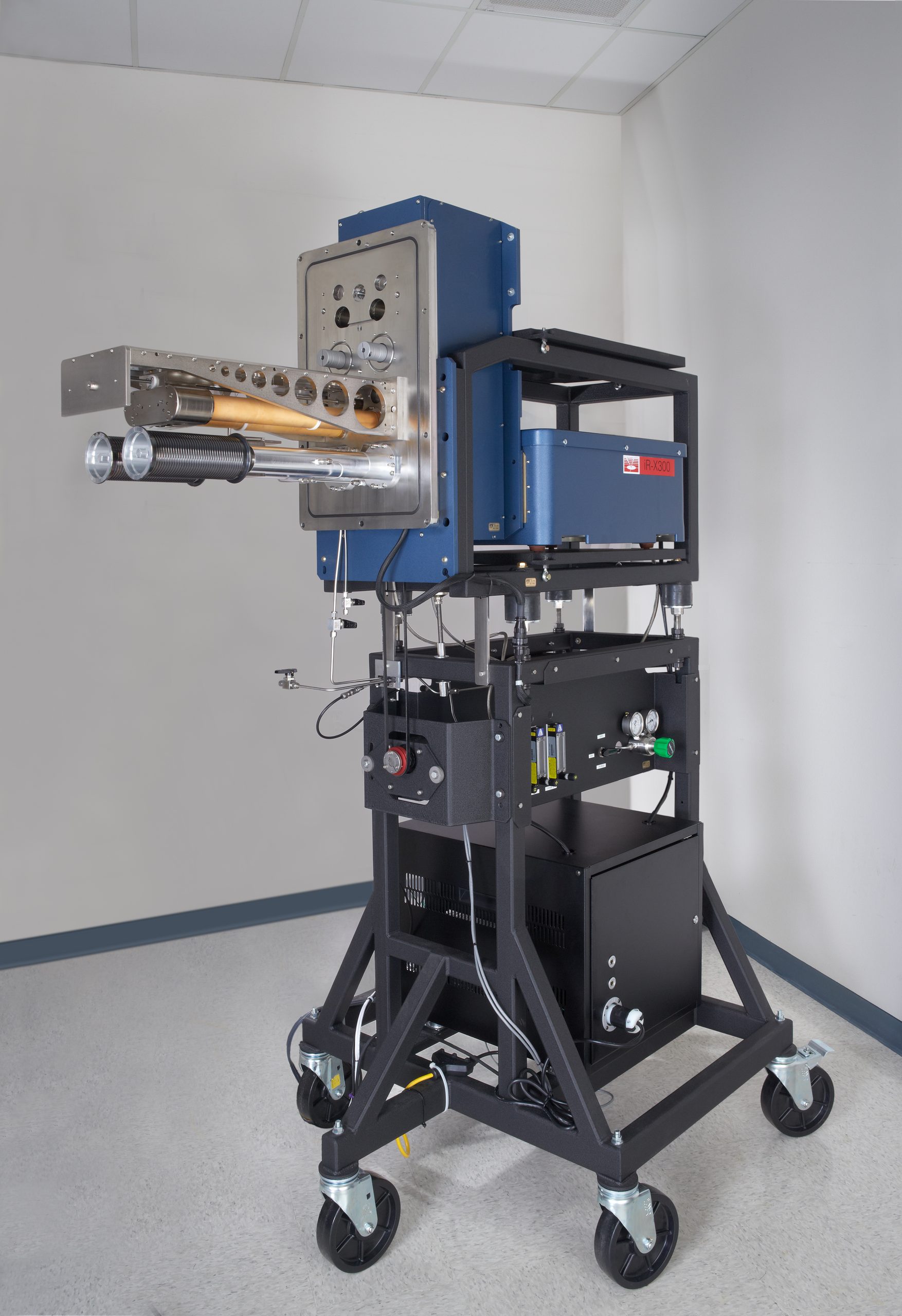
Another example within SOC’s industrial inspection product line is the iRX Machine, which employs FTIR spectroscopy for comprehensive, multipoint inspection of manufactured products. The iRX system scans across product surfaces using a traversing optical assembly, enabling detailed chemical analysis in real time. Its integrated components include a high-performance spectrometer, precision optics, vacuum interface, gas purge, industrial-grade computer, and control electronics.
Designed for fully automated operation, the iRX is both self-calibrating and self-validating, applying multiple AI developed chemometric models to verify material composition and perform quantitative analysis. All validation and quality control (QC) data are automatically archived and reported, ensuring traceability and compliance with production standards.
Custom Instrumentation Engineering
Surface Optics develops application-specific spectroscopic systems spanning:
- Optical system engineering
- Hyperspectral imaging integration
- FTIR process instrumentation
- Chemometric model development
- Industrial enclosure design
- PLC and SCADA integration
- Automated process monitoring software
Custom Industrial Spectroscopy Solutions
Talk to an application scientist
Enquiries are welcomed from aerospace, defense, industrial manufacturing, and advanced materials organizations evaluating real-time spectroscopic process monitoring solutions for production environments.
Prefer to call?
✆ 1-858-675-7404