
Food manufacturers today face unprecedented demands: greater throughput, stricter safety standards, zero-tolerance defect rates, and expectations for consistent product quality. Traditional tools – RGB cameras, manual sampling, and visual inspection – struggle to keep pace with these demands.
Recent research by Zhao et al. (2023) published in LWT – Food Science and Technology use near-infrared (NIR) hyperspectral imaging combined with interpretable machine learning models to access tomato quality and maturity, which determine the flavor of the produce itself as well as any processed products made from it.
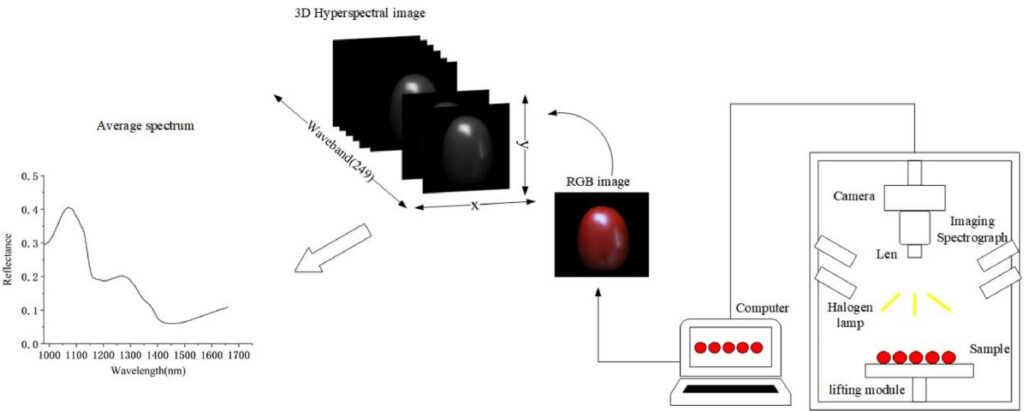
While the study focuses on processing tomatoes, the principles apply broadly across food manufacturing. When implemented using Surface Optics Corporation hyperspectral imaging systems, particularly the SOC 710-SWIR, these methods are streamlined and can be expanded for inline, automated inspection on production lines.
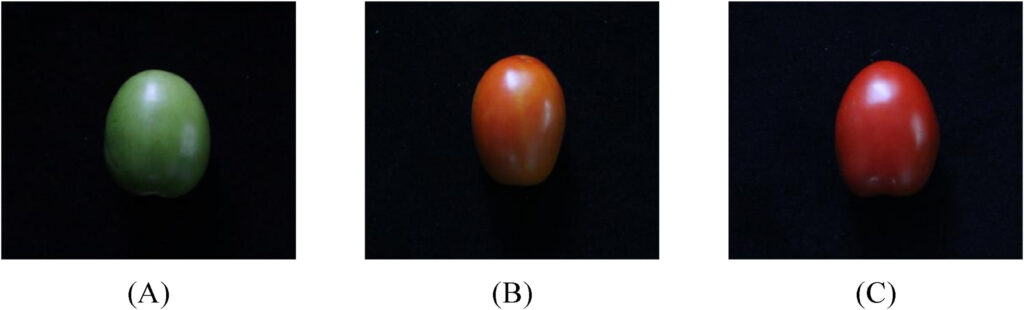
Changes in the flavor of processed foods are often due to raw-material variability. This variability lies in the quality or maturity of a fruit or vegetable, which, for tomatoes, can be quantified based on the firmness, soluble solids content, titratable acids percentage, and lycopene concentration. Hyperspectral imaging can predict these values through capturing and analyzing the spectral information.
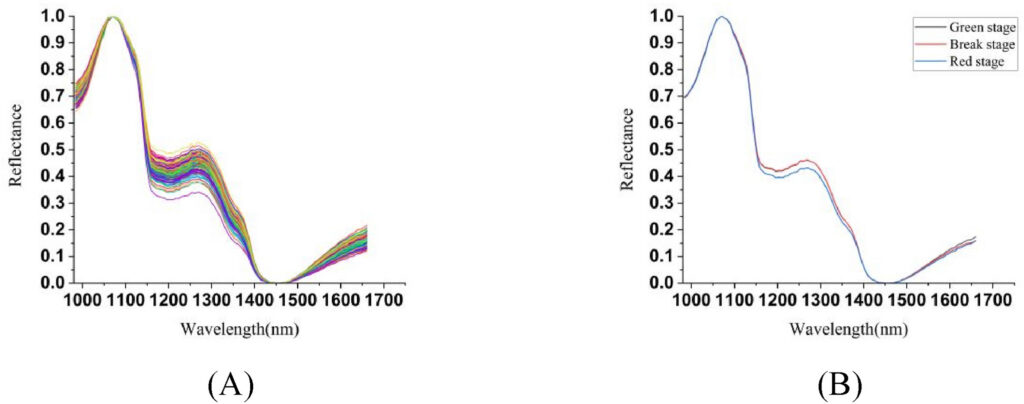
Zhao et al. (2023) assess the accuracy of hyperspectral imaging combined with various classification models — random forest (RF), partial least squares (PLS), and recurrent neural network (RNN) — by comparing spectral-predicted values of firmness, soluble solids content, titratable acidity, and lycopene content against their measured counterparts. They found that the spectra in the wavelength range 1384–1417 nm was consistently an extremely high indicator of the maturity and quality of the tomato. The final results determined that the RNN model demonstrated the higher accuracy, precision, and recall in classification of the tomato fruit maturity stage, with results of 96.6%, 97.2%, and 95.2% respectively.
Near-infrared hyperspectral imaging has moved from academic research into practical manufacturing reality. As demonstrated by Zhao et al. (2023), the technology can determine food quality and maturity with high accuracy. This principle and use can be expanded to a variety of applications. From the rigorous spectral data that hyperspectral imaging offers, vast applications and quality assurance use cases become possible.
For food manufacturers, this means faster decisions, better product utilization, and higher overall efficiency — all while meeting the growing demands of modern food production. On a production line, this capability would enable:
- Automated maturity grading
- Consistent quality classification across batches
- Routing of raw materials to the correct downstream process (e.g., fresh pack, paste, sauce, or canning)
Using the Surface Optics 710-SWIR, these decisions are made continuously and objectively, replacing manual inspection and subjective judgment.
Surface Optics Corporation brings decades of experience in spectral measurement to industrial hyperspectral imaging. The 710 hyperspectral imaging line is particularly well suited for food manufacturing because it offers:
- Broad VIS–NIR spectral coverage aligned with food quality indicators
- High spectral resolution for fine material discrimination
- Robust, production ready design for industrial environments
Rather than functioning as a standalone inspection tool, the 710 becomes an intelligent sensor embedded directly into the manufacturing control system.
Stay tuned for continued updates to the SOC-710 hyperspectral imaging line.
GET IN TOUCH