
Abstract: In thermal control design, stray-light suppression, and infrared sensor performance, the angular distribution of reflected energy is often as important as the total reflectance magnitude. This paper focuses on the “roughness crossover” regime—where a surface transitions from predominantly diffuse (Lambertian-like) scattering to predominantly specular (mirror-like) reflection. Using high-fidelity hemispherical-directional reflectance (HDR) measurements, we demonstrate how controlled surface preparation can drive massive shifts in optical signatures across the 2–25 µm range, even when the total reflectance remains nearly identical across samples.
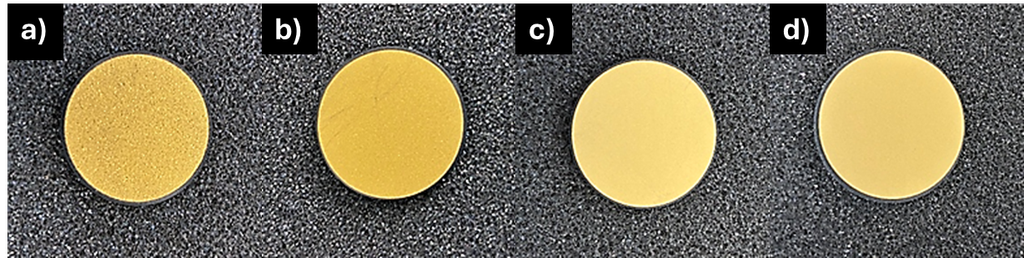
1. The Rayleigh Criterion: A Practical Definition of “Smooth”
A surface is not inherently “rough” or “smooth”—it is defined relative to the incident wavelength. The Rayleigh criterion connects surface height variations to phase differences between rays reflected from peaks and valleys. Under typical assumptions, the specular component (RS) is an exponential attenuation relative to the ideal smooth-surface reflectance (R0):
RS = R0 · e-(4πσ cosθ / λ)²
where σ is RMS roughness, θ is angle of incidence, and λ is wavelength. The practical implication is that as wavelength increases into the MWIR and LWIR, fixed surface features become “electrically small.” This causes a surface that appears matte in the visible to transition into a high-intensity specular reflector in the infrared.
2. Methodology: Measuring Total, Specular, and Diffuse HDR with the SOC-100
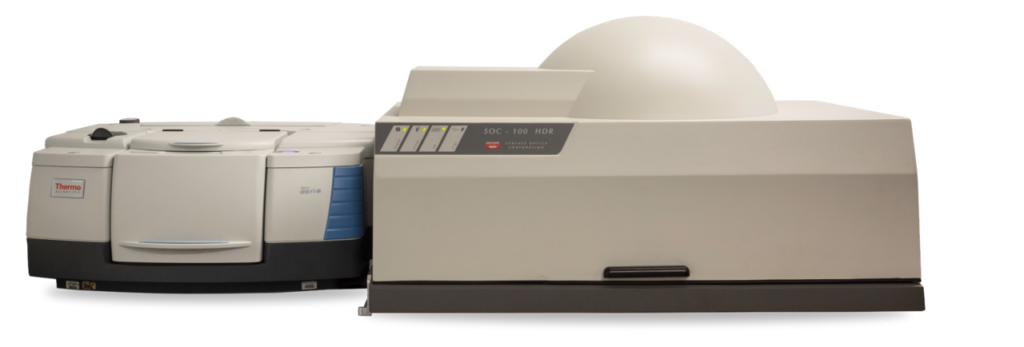
To move beyond theoretical approximations, we utilized the SOC-100 Hemispherical Directional Reflectometer (HDR) for this study. As shown in Figure 1, the SOC-100 is typically integrated with a high-performance FTIR spectrometer, creating a powerful diagnostic suite capable of rapid, spectrally resolved measurements across the full mid-to-longwave infrared range.
Hardware Architecture & Physical Blocking
The core of the SOC-100’s precision lies in its unique optical architecture, illustrated in the schematic in Figure 2. The system utilizes a controlled thermal source—a blackbody heated to 700°C (1300°F)—coupled with a large, 18-inch gold-coated hemiellipsoid. This geometry ensures that the sample is illuminated from a full 2π steradian field, effectively simulating the uniform hemispherical radiative environments found in complex aerospace and defense applications.
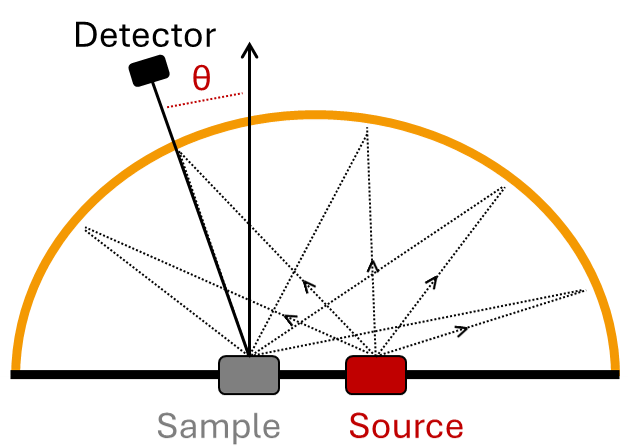
A critical differentiator of this hardware is the physical, automated specular beam blocker. While many standard characterization methods rely on mathematical modeling or “best-guess” assumptions to separate scattering components, the SOC-100 employs a mechanical blocker to physically occlude the ± 5° specular lobe. This allows for a three-step process:
- Total HDR: The system first measures the total reflected energy from the sample.
- Diffuse Isolation: The automated blocker is moved into the optical path to physically remove the specular component, allowing for a direct measurement of the Diffuse HDR.
- Specular Derivation: The specular component is then accurately derived by subtracting the diffuse measurement from the total: Specular = Total – Diffuse.
This empirical approach is fundamentally superior to modeling alone. By capturing the actual physical redistribution of energy, we can observe exactly how the specular lobe strengthens or widens as a surface enters the “roughness crossover” regime, rather than assuming the surface follows an idealized theoretical distribution.
3. Results: Spectral HDR Mapping and the Crossover Phenomenon
The spectral curves in Figure 3 provide a high-fidelity map of how energy is redistributed as a surface transitions from “rough” to “smooth” relative to the incident wavelength. By partitioning the total reflectance into specular and diffuse components, we can clearly observe the roughness crossover—the specific spectral region where the dominant scattering mechanism shifts.
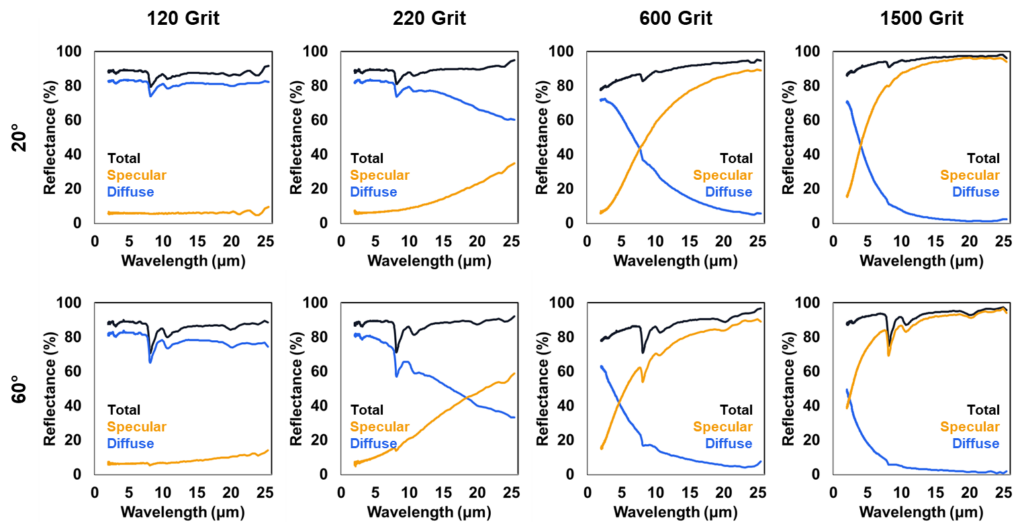
In the shorter wavelengths (2–5 μm), the 120-grit and 600-grit samples both behave as near-ideal Lambertian scatterers, with the diffuse component accounting for nearly 90% of the total reflected energy. However, as we progress into the MWIR and LWIR, a distinct pivot occurs. While the 120-grit sample remains predominantly diffuse throughout the measured spectrum, the specular fraction of the 600-grit finish rises rapidly through the 8–12 μm atmospheric window, eventually exceeding the diffuse component. By the time we reach 20 μm, the surface that appeared “matte” in the visible spectrum is now reflecting over 90% of its energy into the specular lobe.
An intermediate state is captured in the 220-grit sample, while the onset of the specular component begins significantly earlier in the 1500-grit sample, as expected. Notably, these trends are accelerated at higher angles of incidence. In the 60° measurements, the “crossover” happens at shorter wavelengths compared to the 20° data. This angular dependency is a critical realization for sensor modelers: a surface may appear diffuse when viewed at near-normal angles but can produce intense specular glints at more oblique, grazing angles.
We also observe a secondary spectral “fingerprint” between 6–10 μm. These features are consistent with the thin protective overcoats typically applied to metallic substrates. Because our measurement is spectrally resolved via FTIR, we can verify that the coating remains continuous and consistent across all grit levels, ensuring that the shifts we see are driven strictly by morphology, not by a change in material composition or coating failure.
4. Discussion: The Deceptive Stability of Total Reflectance
The most significant engineering takeaway from this study is the deceptive stability of total reflectance. As shown in Figure 4, while the specular and diffuse components undergo dramatic, order-of-magnitude shifts, the Total HDR remains remarkably consistent across all surface finishes. Even as the 600-grit sample transitions from 90% diffuse to 90% specular, the total hemispherical reflectance barely fluctuates.
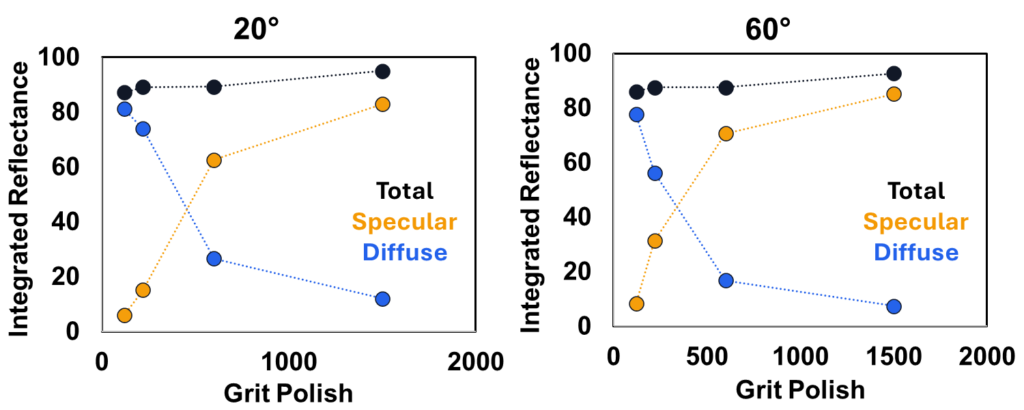
This leads to a critical realization for the modeling community: “Total Reflectance” is an incomplete descriptor for high-fidelity system design. If an engineer relies solely on a hemispherical total (or a single-wavelength “constant”), they might conclude that these four samples are identical. In reality, their operational signatures—how they “look” to a sensor—are fundamentally different. A sensor tracking a 1500-grit asset will encounter intense, directional glints, while a 120-grit asset will appear as a predictable, low-intensity background scatterer.
Furthermore, our data confirms that “Grit” is a process descriptor, not a material property. Because factors like pressure, directionality, and substrate hardness vary during preparation, “120-grit” does not guarantee a specific scattering distribution. For high-stakes applications—such as stray-light suppression in hyperspectral imagers or glint prediction for SSA—surface morphology must be treated as a primary design parameter. To ensure inter-laboratory reproducibility and model validation, these results suggest that specular/diffuse partitioning should be paired with traceable surface metrology (σ and slope statistics) rather than relying on qualitative finish labels.
5. Why This Matters for Thermal Design and Emittance Studies
In many thermal workflows, absorptance is estimated from reflectance, and emittance is then derived from that absorptance. If a design problem is purely hemispherical—such as calculating bulk cooling rates for a satellite in a steady-state environment—total reflectance may be the dominant driver. However, many real-world aerospace and defense systems are highly geometry-sensitive.
Apparent radiance, view-angle behavior, “glint” risk, and EO/IR signature predictions depend entirely on how energy is distributed between specular and diffuse channels. This study demonstrates that surface specification is a crucial input to thermal design and must be documented as part of any radiative-property test plan. Relying on “Total Reflectance” constants can hide significant operational risks, particularly in the MWIR and LWIR where the roughness crossover is most pronounced. By accounting for these morphology-driven shifts, engineers can achieve higher-fidelity system modeling, ensuring that complex radiative data translates into actionable engineering insights for extreme environments.
6. Conclusion
Roughness is not a static label; it is a wavelength- and geometry-dependent interaction. The data presented here demonstrates a measurable diffuse-to-specular transition across the 2–25 μm range, driven primarily by surface finish. By recognizing that total reflectance often hides these critical shifts, engineers can better predict glint, apparent radiance, and thermal performance in complex environments. At its core, high-fidelity modeling requires high-fidelity data—moving beyond “grit” to traceable, partitioned measurements.
Partner with Our Measurement Services Laboratory
Our lab offers the industry-leading SOC-100 HDR to provide the high-fidelity characterization required for modern aerospace and defense missions. We specialize in providing the engineering community with the actionable insights needed to bridge the gap between material science and system-level modeling.
- Broad IR Spectral Range: 2 – 100 µm
- Angular Resolution: 8-80°, 0.1° Resolution
- Specular and Diffuse Partitioning: Empirical separation via automated beam-blocking
- Polarization Control: Independent S- and P- measurements
- Modes: Reflectance and Transmittance Measurements, Emittance Calculations
- Complementary Data: VIS-NIR-SWIR coverage from 200-2500 nm available
GET IN TOUCH